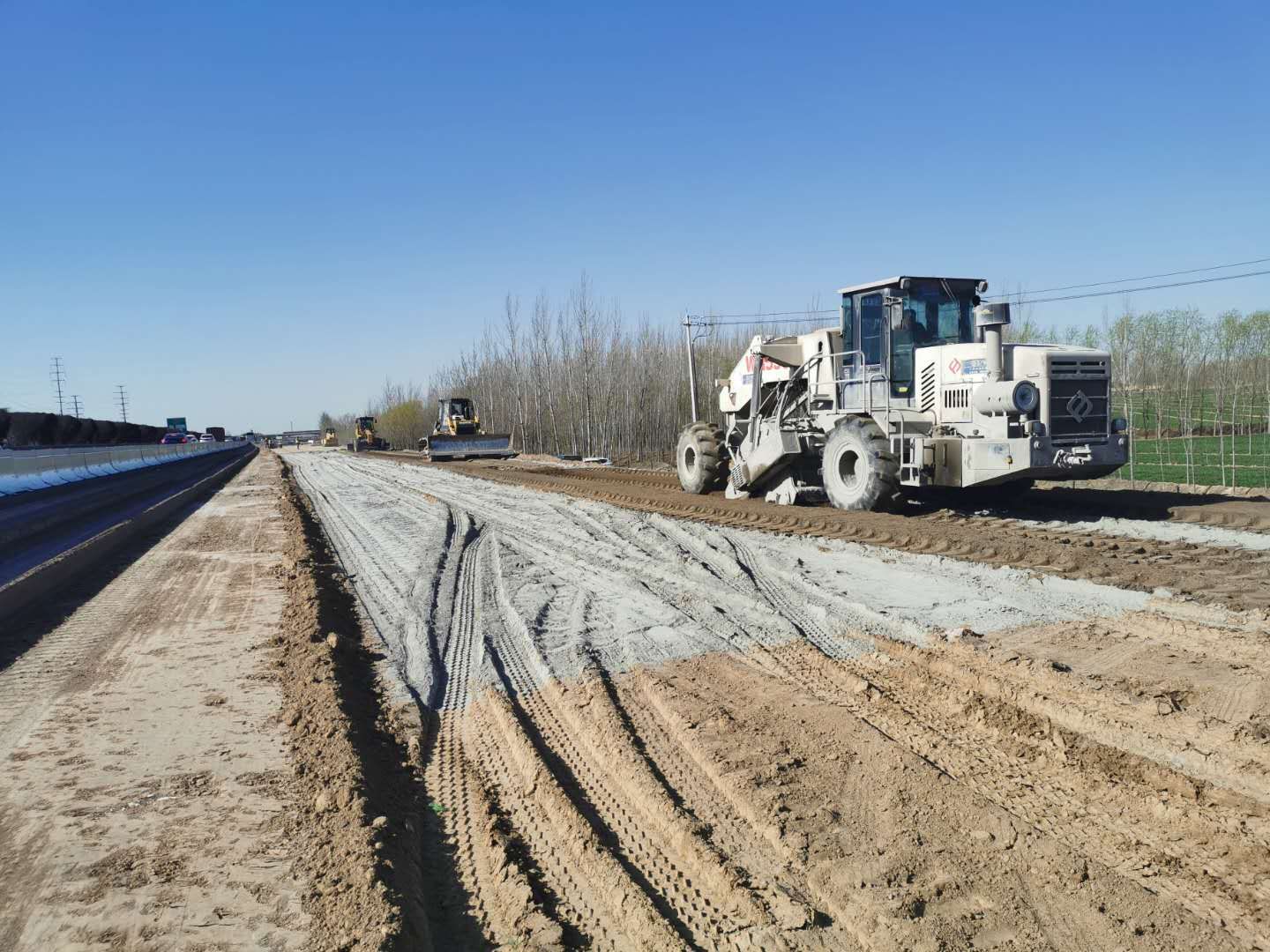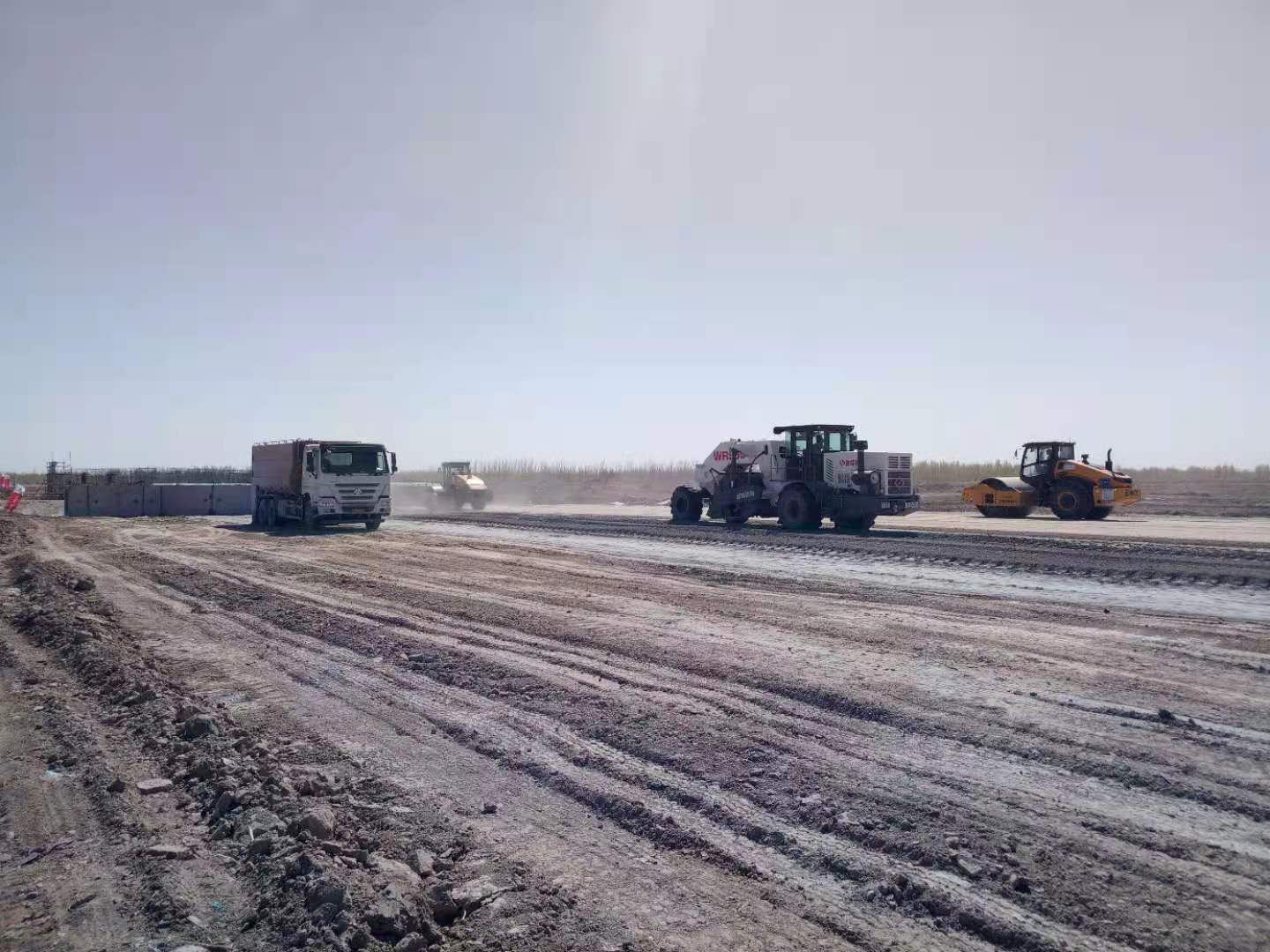


山東途暢路橋工程有限公司
聯系人:石總
電話:18264104888
地址:山東省濟南市槐蔭區經一路273號群盛華城
冷再生機租賃:道路冷再生時粒徑過大該怎么處理
1 總 則
1 General Provisions
1.1 冷再生是一種利于和節約能源的道路維修方式。為推廣此項技術,保證冷再生設計施工質量,特制定本指南。
1.1 Cold regeneration is a road maintenance method that is beneficial for environmental protection and energy conservation. To promote this technology and ensure the quality of cold recycling design and construction, this guide is specially formulated.
1.2 本指南規定了水泥穩定就地冷再生的設計方法、設計要點及施工工藝和質量控制要求。
1.2 This guideline specifies the design methods, key points, construction techniques, and quality control requirements for on-site cold recycling of cement stabilization.
1.3 本指南適用于采用水泥穩定就地冷再生技術進行大修、改建的各等級公路的底基層和二級及二級以下公路、城市出口路基層的施工。
1.3 This guide is applicable to the construction of sub base layers and sub base layers of various grades of highways, as well as urban exit road bases, that undergo major repairs and renovations using cement stabilized in-situ cold recycling technology.
1.4 本指南中的規定、要求與《遼寧省“十一五”公路技術政策(試行)》中相應內容不一致時,以本指南為準。
In case of any inconsistency between the provisions and requirements in this guide and the corresponding content in the "Eleventh Five Year Plan" Highway Technology Policy (Trial) of Liaoning Province, this guide shall prevail.
1.5 水泥穩定就地冷再生路面設計應采用設計與施工緊密結合的半剛性基層設計理論,設計內容包括交通量預測與分析、舊路混合料分析、混合料配合比設計、設計參數確定、路面結構組合設計與厚度計算,在進行路面結構技術經濟綜合評價的基礎上提出設計方案。
The design of 1.5 cement stabilized in-situ cold recycled pavement should adopt a semi-rigid base design theory that closely combines design and construction. The design content includes traffic volume prediction and analysis, analysis of old road mixtures, mix design, determination of design parameters, pavement structure combination design and thickness calculation. Based on the comprehensive evaluation of pavement structure technology and economy, a design scheme should be proposed.
1.6 就地冷再生機的再生深度一般為15cm -30cm。損壞深度大于30cm或需要提高或改善路面使用功能時,采用水泥穩定就地冷再生基層后,應加鋪滿足設計強度的半剛性上基層,路面結構按《公路瀝青路面設計規范》有關規定,通過交通量預測計算設計彎沉值后,進行路面結構厚度計算,并進行彎拉應力驗算。
The regeneration depth of the on-site cold regeneration machine is generally 15cm -30cm. When the depth of damage is greater than 30cm or when it is necessary to improve or enhance the functionality of the road surface, after using cement stabilized on-site cold recycled base layer, a semi-rigid upper base layer that meets the design strength should be added. The road surface structure should be designed according to the relevant provisions of the "Design Specification for Asphalt Pavement of Highways". After calculating the design deflection value through traffic volume prediction, the thickness of the road surface structure should be calculated, and the bending tensile stress should be verified.
1.7 本指南涉及的試驗方法應符合現行有關試驗規程的規定。
1.7 The test methods involved in this guideline shall comply with the current relevant test regulations.
1.8 再生前必須進行路況調查,確定路面損壞是于路面面層,還是屬于路面結構問題,了解路面結構損壞的范圍和深度。
Before regeneration, a road condition survey must be conducted to determine whether the road damage is limited to the surface layer or a structural issue, and to understand the scope and depth of the road structure damage.
1.9 再生施工中除進行路面混合料級配檢測外,應避免預破碎,在必須采用預破碎的路段,應嚴格控制銑刨深度。
In addition to conducting gradation testing on road mixtures during the 1.9 recycling construction, pre crushing should be avoided. In sections where pre crushing is necessary, the milling depth should be strictly controlled.
1.10 進行室內材料配合比設計所需混合料原則上應用再生機進行現場取料(即舊路混合料)。不同結構路段應獨立進行結構組合設計和混合料配合比設計。
The required mixture for indoor material mix design should generally be collected on-site using a recycling machine (i.e. old road mixture). Different structural sections should be independently designed for structural combinations and mix proportions.
1.11 就地再生設備應能精確控制再生深度,誤差不宜超過10mm;應能根據要求調整橫坡,適當調整再生料的級配;應能控制添加料的比例并根據需要自動調節。
1.11 The on-site regeneration equipment should be able to accurately control the regeneration depth, with an error not exceeding 10mm; it should be able to adjust the cross slope according to requirements and adjust the grading of the regenerated material appropriately; Should be able to control the proportion of additives and automatically adjust as needed.
1.12 下列情況原則上不宜采用就地水泥穩定就地冷再生技術:
1.12 In principle, on-site cement stabilization and on-site cold recycling technology should not be used in the following situations:
(1)在預估的再生深度范圍內,存在過多超粒徑顆粒(粒徑超過10cm的砂礫或鐵渣等),會對銑刨轉子造成損害的道路;
(1) Within the estimated regeneration depth range, there are too many oversized particles (such as gravel or iron slag with a maximum particle size exceeding 10cm) that can cause damage to the milling rotor on the road;
(2)病害較多,變形嚴重,強度不足的道路;
(2) Roads with multiple diseases, severe deformation, and insufficient strength;
(3)舊路結構層總厚度(面層、基層及墊層之和)小于25cm的道路。
(3) Roads with a total thickness of less than 25cm for the structural layer of the old road (the sum of the surface layer, base layer, and cushion layer).
1.13 瀝青路面面層厚度不大于7cm可采用水泥穩定就地冷再生,面層厚度大于7cm 宜在水泥穩定就地冷再生和泡沫瀝青穩定就地冷再生兩個方案之間進行技術經濟比較后確定。
1.13 Cement stabilized in-situ cold recycling can be used for asphalt pavement with a thickness of no more than 7cm. For pavement with a thickness of more than 7cm, it should be determined after technical and economic comparison between cement stabilized in-situ cold recycling and foam asphalt stabilized in-situ cold recycling.
1.14 施工中應認真整理相關資料,不斷總結施工方法和實踐經驗,以提高冷再生施工技術水平,并為本指南的修訂提供真實可靠的實踐依據。
During construction, relevant materials should be carefully organized, and construction methods and practical experience should be continuously summarized to improve the level of cold recycling construction technology and provide real and reliable practical basis for the revision of this guide.
2 術 語
2 Terminology
2.1 冷再生技術(Cold recycling)
2.1 Cold Recycling Technology
將需要改建或大修的舊路面,經過翻挖回收、破碎、篩分,并加入適量的穩定劑(水泥、乳化瀝青、泡沫瀝青等),在常溫情況下重新拌和,形成具有一定路用性能的再生混合料,用于鋪筑路面基層或底基層的整套工藝技術。
The old pavement to be reconstructed or overhauled shall be excavated, recycled, crushed, screened, and added with a proper amount of stabilizer (cement, emulsified asphalt, foam asphalt, etc.), and remixed at normal temperature to form a recycled mixture with certain road performance, which is used for the whole process technology of paving the pavement base or subbase.
2.2 舊混合料(Recycled mixtures)
2.2 Recycled mixtures
對需要再生的道路按規定要求進行整形處理,經再生機(或銑刨機)按規定的深度、行進速度和轉子速度進行銑刨后得到的具有一定級配的混合料。
The mixture with a certain gradation is obtained by shaping the road that needs to be regenerated according to the prescribed requirements, and milling it with a recycling machine (or milling machine) according to the prescribed depth, travel speed, and rotor speed.
2.3 水泥穩定就地冷再生(Cold recycling with cement as stabilizing agent)
2.3 Cold recycling with cement as stabilizing agent
在舊混合料(必要時加入一定比例的新料)中,加入一定劑量的水泥,在含水量狀態下拌和形成再生混合料,通過整形、碾壓、養生形成符合設計要求的道路基層或底基層。
In the old mixture (with a certain proportion of new material added if necessary), a certain amount of cement is added and mixed at the optimal moisture content to form a recycled mixture. Through shaping, rolling, and curing, a road base or subbase that meets the design requirements is formed.
2.4 再生深度(Recycling depth)
2.4 Recycling depth
再生機設定的銑刨深度,一般指原道路標高與再生層底部標高之差。
The milling depth set by the regeneration machine generally refers to the difference between the original road elevation and the bottom elevation of the regeneration layer.
2.5 再生厚度(Recycling thickness)
2.5 Recycling thickness
再生層設計頂面標高與底面標高之差,指再生層碾壓成型后的頂面標高與底面標高之差。
The difference between the top and bottom elevations of the recycled layer design refers to the difference between the top and bottom elevations of the recycled layer after rolling and forming.
2.6 均勻路段(Homogeneous road section)
2.6 Homogeneous Road Section
舊路中結構組成及各結構層材料相同或相似并且具有相似結構承載力的路段。
The old road section has the same or similar structural composition and materials of each structural layer, and has similar structural bearing capacity.
3 一般規定
3 General Provisions
3.1 水泥穩定就地冷再生混合料用做基層或底基層時,水泥劑量可采用4%-5%,一般不宜超過5.5%。
When using cement stabilized in-situ cold recycled mixture as base or subbase, the cement dosage can be 4% -5%, and generally should not exceed 5.5%.
3.2 水泥穩定就地冷再生結構層宜在春末和氣溫較高季節組織施工。施工期的日氣溫應在5℃以上,在有冰凍的地區,并應在次重冰凍(-3~-5℃)到來之前半個月到一個月完成。
3.2 Cement stabilized in-situ cold recycling structural layer should be constructed in late spring and high temperature seasons. The daily minimum temperature during the construction period should be above 5 ℃, in areas with freezing, and should be completed half a month to a month before the first heavy freezing (-3~-5 ℃) arrives.
3.3 在雨季施工時,應特別注意氣候變化,勿使水泥和混合料遭雨淋。降雨時應停止施工,已經攤鋪的水泥混合料應盡快碾壓密實。
3.3 During rainy season construction, special attention should be paid to climate change to prevent cement and mixtures from being exposed to rain. Construction should be stopped during rainfall, and the already spread cement mixture should be compacted as soon as possible.
3.4 水泥穩定就地冷再生結構層施工時,應遵守下列規定:
When constructing the cement stabilized in-situ cold recycling structural layer, the following regulations should be followed:
(1) 添加的碎石等外摻料和水泥應撒布均勻。
(1) The added crushed stone and other additives, as well as cement, should be evenly spread.
(2) 應嚴格控制基層厚度和高程,其路拱橫坡應與面層基本一致。
(2) The thickness and elevation of the base layer should be strictly controlled, and the cross slope of the road arch should be basically consistent with the surface layer.
(3) 應在混合料處于或略大于含水量(氣候炎熱干燥時,基層混合料可大1%~2%)時進行碾壓,壓實度應達到《公路路面基層施工技術規范》(JTJ 034-2000)的有關要求。當使用大噸位壓路機時,壓實度宜提高1%~2%。
(3) Rolling should be carried out when the mixture is at or slightly above the optimal moisture content (when the climate is hot and dry, the base layer mixture can be 1% to 2% higher), and the compaction degree should meet the relevant requirements of the "Technical Specification for Construction of Highway Pavement Base Layer" (JTJ 034-2000). When using a large tonnage roller, the compaction degree should be increased by 1% to 2%.
(4) 水泥穩定就地冷再生結構層宜采用18t以上的振動壓路機碾壓。壓實厚度15-20cm,采用18~20t振動壓路機碾壓;超過20 cm以上壓實厚度應采用25t以上振動壓路機。冷再生結構層碾壓工序應在水泥初凝前完成。
(4) The cement stabilized in-situ cold recycling structural layer should be compacted with a vibratory roller weighing at least 18 tons. The compaction thickness is 15-20cm, and a 18-20t vibratory roller is used for rolling; For compaction thickness exceeding 20 cm, a vibratory roller with a capacity of 25 tons or more should be used. The rolling process of the cold recycled structural layer should be completed before the initial setting of the cement.
3.5 各級公路用水泥穩定就地冷再生混合料的壓實度、7d齡期無側限抗壓強度應符合表3.1的規定。
The compaction degree and 7-day unconfined compressive strength of cement stabilized in-situ cold recycled mixtures used for highways at all levels shall comply with the provisions of Table 3.1.
3.6 水泥穩定就地冷再生混合料的組成設計應根據表3.1的強度標準,通過試驗確定必需的水泥劑量和混合料的含水量,在需要改善混合料的物理力學性質或級配時,還應確定摻加新料的規格和比例。
3.6 The composition design of cement stabilized in-situ cold recycled mixture should be based on the strength standards in Table 3.1, and the necessary cement dosage and optimal moisture content of the mixture should be determined through experiments. When it is necessary to improve the physical and mechanical properties or gradation of the mixture, the specifications and proportions of adding new materials should also be determined.
3.7 水泥穩定就地冷再生的各項試驗應按《公路工程無機結合料穩定材料試驗規程》(JTJ057)進行。
The various tests for on-site cold recycling of cement stabilization should be conducted in accordance with the "Test Code for Inorganic Bonding Materials in Highway Engineering" (JTJ057).
表3.1 水泥穩定就地冷再生混合料的抗壓強度標準
Table 3.1 Compressive Strength Standards for Cement Stabilized In situ Cold Recycled Mixtures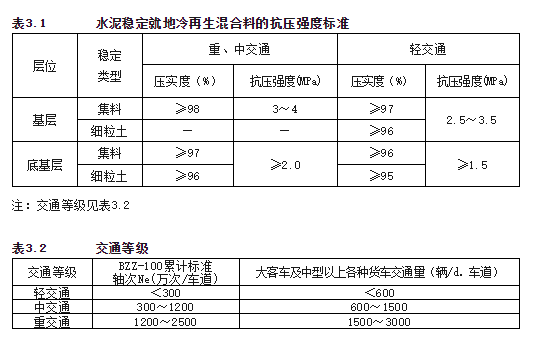
4 路況調查
4 Road condition investigation
4.1 收集查閱相關資料
4.1 Collect and review relevant materials
(1) 原路面設計情況以及路面設計的任何變化;
(1) The original pavement design and any changes in pavement design;
(2) 路面各結構層厚度及材料的詳細情況;
(2) Detailed information on the thickness and materials of each structural layer on the road surface;
(3) 施工記錄的施工工藝和質檢測試結果;
(3) Construction process and quality inspection test results recorded in the construction records;
(4) 路面使用過程中維修養護的詳細情況(包括工藝、材料等);
(4) Detailed information on maintenance and upkeep during the use of road surfaces (including processes, materials, etc.);
(5) 歷史交通量資料。
(5) Historical traffic volume data.
4.2 劃分均勻路段
4.2 Division of Uniform Road Sections
4.2.1 通過獲取的歷史資料初步判定原道路的均勻路段,道路結構組合相差較大或結構層材料相差較大的路段不宜作為一個均勻路段。
4.2.1 Based on the obtained historical data, it is preliminarily determined that the original road section is uniform. Road sections with significant differences in road structure combinations or structural layer materials should not be considered as uniform sections.
4.2.2 對原道路進行彎沉測量,根據累積總和法初步確定均勻路段。
4.2.2 Conduct deflection measurement on the original road and preliminarily determine the uniform road section based on the cumulative sum method.
較大彎沉值(即兩輪讀數中的較大值)的累積總和法采用公式4.1計算:
The cumulative sum method of larger deflection values (i.e. the larger of the two readings) is calculated using formula 4.1:
(4.1)
(4.1)
——i點的累積彎沉總和值
——Accumulated total deflection of point i
——i點的較大彎沉值
——The larger deflection value of point i
——整個路段較大彎沉的平均值
——The average value of significant deflection for the entire road section
——i點前一點的累積彎沉總和值(i=1時,其值為0)
——The cumulative total deflection of the point before point i (when i=1, its value is 0)
將累積總和值繪制在相應路段上,相對恒定的斜坡值表明這些路段具有相似的路面反應。示例見圖4.1(圖中彎沉值單位為0.01mm)。
Plot the cumulative total value on the corresponding road sections, where relatively constant slope values indicate similar road surface responses. See Figure 4.1 for an example (the deflection value in the figure is in 0.01mm).
4.2.3 視覺評價
4.2.3 Visual evaluation
1. 視覺評價通常徒步進行。對于較長的路段,可采用慢速駕車完成評價。當駕車時,為了近距離仔細觀察,需要經常停車。
Visual evaluation is usually conducted on foot. For longer road sections, slow driving can be used to complete the evaluation. When driving, frequent parking is necessary for close observation.
2. 視覺評價時,要記錄整幅路面內所有明顯的損壞以及其它觀測結果,諸如排水、地質變化以及路段幾何特征(比如陡坡、急轉彎以及高填方路堤)。
When conducting visual evaluation, it is necessary to record all obvious damages and other observation results within the entire road surface, such as drainage, geological changes, and geometric features of the road section (such as steep slopes, sharp turns, and high fill embankments).
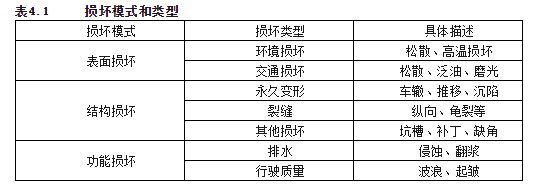
3. 檢查過程中,損壞模式分為三類,表面損壞、結構損壞、功能損壞,各種損壞模式、損壞類型及具體描述見表4.1。在視覺調查中,依據損壞嚴重程度、頻率和位置,對道路損壞的不同模式和類型進行具體描述。
During the inspection process, the damage modes are divided into three categories: surface damage, structural damage, and functional damage. The various damage modes, types, and specific descriptions are shown in Table 4.1. In visual surveys, different patterns and types of road damage are described in detail based on the severity, frequency, and location of the damage.
表4.1 損壞模式和類型
Table 4.1 Damage Modes and Types
4. 對視覺調查資料進行總結,明確路面的破壞模式,為道路損壞的原因提供有價值的線索。
4. Summarize the visual survey data, clarify the damage mode of the road surface, and provide valuable clues for the causes of road damage.
4.4 均勻路段的再評估
4.4 Re evaluation of Uniform Road Sections
結合視覺調查中獲取的資料,以及所有其他可能的相關資料對由彎沉分析限定的“均勻路段”進行再次評價,以更加精確地描述各類均勻路段,更精確地對相似的“相同路段”進行識別和歸類。
Based on the data obtained from visual surveys and all other possible relevant information, re evaluate the "uniform road sections" defined by deflection analysis to more accurately describe various types of uniform road sections and more accurately identify and classify similar "same road sections".
4.5 詳細調查
4.5 Detailed Investigation
對每一相似的“均勻路段”,需要進行詳細調查,以便對原路面結構進行評價(組成與損壞模式),確定舊路地基承載力。
For each similar 'uniform road section', a detailed investigation is required to evaluate the original pavement structure (composition and damage mode) and determine the bearing capacity of the old road foundation.
4.5.1 開挖測試坑
4.5.1 Excavation of Test Pit
1. 對每一均勻路段,測試坑每每車道應不少于一個。通常在車道外側輪跡帶開挖,也可在硬路肩(或路緣帶)與行車道的交界線處開挖。
For each uniform road section, there should be no less than one test pit per kilometer per lane. Excavation is usually carried out on the outer side of the lane's wheelbase, but can also be done at the boundary between the hard shoulder (or curb) and the lane.
2. 測試坑用于確定舊路各結構層厚度和材料、現場含水量、各結構層的性狀(如開裂程度、水泥穩定層的水泥粘結度或碳酸化程度)等舊路基本信息。
2. Test pits are used to determine basic information about the old road, such as the thickness and materials of each structural layer, on-site moisture content, and the characteristics of each structural layer (such as cracking degree, cement bonding degree or carbonation degree of cement stabilized layer).
3. 測試坑通常長1.2m、寬1m、深0.5-1m,具體尺寸可根據道路結構進行調整。
3. The test pit is usually 1.2m long, 1m wide, and 0.5-1m deep, and the specific size can be adjusted according to the road structure.
4. 測試坑需仔細開挖,每層材料應分開堆放,以便取樣。樣品應放置在密封的容器內,用于測定含水量。測試坑開挖完畢,應拍照并詳細記錄測試坑的路面輪廓。
4. The test pit needs to be carefully excavated, and each layer of material should be stacked separately for sampling. The sample should be placed in a sealed container for measuring moisture content. After the excavation of the test pit is completed, photos should be taken and the road surface contour of the test pit should be recorded in detail.
4.5.2 現場承載板試驗
4.5.2 On site bearing plate test
1. 現場承載板試驗宜選在一年中的不利季節進行。測點位置與測試坑相同,也可在試驗的基礎上兩者同步進行。
1. The on-site bearing plate test should be conducted during the most unfavorable season of the year. The location of the measuring point is the same as that of the testing pit, and the two can also be synchronized based on the experiment.
2. 對每一均勻路段,每車道應不少于兩個測點,同一均勻路段中若某一測點的數值高于(或低于)平均值的30%,應增加測點數量,同時對數值過低點附近的路段應仔細調查,看是否存在路基沉陷等下部結構層損壞問題。
2. For each uniform road section, each lane should have no less than two measuring points. If the value of a measuring point in the same uniform road section is higher (or lower) than 30% of the average value, the number of measuring points should be increased. At the same time, the road section near the low point of the value should be carefully investigated to see if there are any problems such as roadbed subsidence or damage to the lower structural layer.
3. 將道路面層認真去除,測定其下部結構層復合回彈模量。同理將道路基層、墊層完全去除,測定其下部結構層復合回彈模量,直模量測定點處的結構層深度大于預估的可能銑刨深度。
3. Carefully remove the road surface layer and measure the composite rebound modulus of its lower structural layer. Similarly, completely remove the road base and cushion layer, and measure the composite rebound modulus of the lower structural layer until the depth of the structural layer at the modulus measurement point is greater than the estimated maximum possible milling depth.
4.6 綜合資料,初步確定再生厚度
4.6 Comprehensive data, preliminary determination of regeneration thickness
綜合分析以上獲得的信息,推測該路面的剩余使用壽命,并識別出承載力的關鍵層,在明確已經損壞結構層的基礎上初步確定再生層的厚度。
Based on the comprehensive analysis of the information obtained above, the remaining service life of the road surface is speculated, and the key layer with the lowest bearing capacity is identified. On the basis of clarifying the damaged structural layer, the thickness of the regeneration layer is preliminarily determined.
5 結構組合設計
5. Structural combination design
5.1 舊路大修、改建時,應根據收集調查的交通量數據,確定交通量增長率,計算設計年限內一個車道的累計當量軸次,結合路面等級及路面類型,采用瀝青路面半剛性設計理論,計算設計彎沉值。
During the major repair and reconstruction of old roads, the traffic growth rate should be determined based on the collected and surveyed traffic volume data, and the cumulative equivalent number of axles for one lane within the design period should be calculated. Combined with the pavement grade and type, the semi-rigid design theory of asphalt pavement should be adopted to calculate the design deflection value.
5.2 初步確定的道路結構組合方案。根據原路面設計強度和路況調查中得到的路面損壞情況,預估冷再生結構層厚度,并挖驗檢測冷再生結構層下承層的當量回彈模量,試算后確定再生層的厚度,一般厚度不宜小于18cm。
5.2 Preliminary determined road structure combination plan. Based on the original pavement design strength and road condition investigation, the thickness of the cold recycled structural layer is estimated, and the equivalent rebound modulus of the underlying layer of the cold recycled structural layer is excavated and tested. After trial calculation, the thickness of the recycled layer is determined, and generally the thickness should not be less than 18cm.
5.3 由路況調查中現場承載板試驗獲得的原路各層下部復合模量,采用內插法確定預估的道路銑刨深度處下層復合模量,以此模量作為再生層底部模量。見圖5.1。
5.3 The composite modulus of the lower layer of the original road obtained from the on-site bearing plate test in the road condition survey is used to determine the estimated composite modulus of the lower layer at the milling depth of the road using interpolation method, and this modulus is used as the modulus of the bottom of the regeneration layer. Refer to Figure 5.1.
5.4 水泥穩定就地冷再生層設計參數應以實測值為準,當缺乏條件無法取得實測值時,可參照下述值進行取值。水泥劑量為4%~5.5%時,抗壓模量E值為1000~1500MPa,劈裂強度為0.4~0.6MPa。
5.4 The design parameters of the cement stabilized in-situ cold regeneration layer should be based on the measured values. When there is a lack of conditions to obtain the measured values, the following values can be used for reference. When the cement dosage is 4%~5.5%, the compressive modulus E value is 1000~1500MPa, and the splitting strength is 0.4~0.6MPa.
5.5 按設計彎沉值驗算結構層厚度。見示意圖5.1。
5.5 Verify the thickness of the structural layer according to the design deflection value. Refer to schematic diagram 5.1.
5.6 驗算結果符合要求則進行下述步驟,如驗算結果不符合要求,則重新擬定結構層組成進行計算,直驗算結果滿足要求為止。
If the verification result meets the requirements, the following steps shall be taken. If the verification result does not meet the requirements, the structural layer composition shall be re formulated for calculation until the verification result meets the requirements.
5.7 進行技術經濟比較,終確定采用的路面結構方案。
5.7 Conduct technical and economic comparisons to ultimately determine the pavement structure scheme to be adopted.
5.1 內插法確定再生層底部模量
5.1 Interpolation method to determine the modulus of the bottom of the regeneration layer
6 混合料組成設計
6. Composition design of mixed materials
6.1 材 料
6.1 Materials
6.1.1 水泥穩定就地冷再生層用做底基層時,銑刨料單個顆粒的粒徑不應超過53mm,其顆粒組成應在表6.1所列范圍內。銑刨料的塑性指數不應超過10。塑性指數大于10的銑刨舊料,宜采用水泥和石灰綜合穩定。
When the cement stabilized in-situ cold recycled layer is used as the base layer, the maximum particle size of a single milling material particle should not exceed 53mm, and its particle composition should be within the range listed in Table 6.1. The plasticity index of milling material should not exceed 10. Milling old materials with a plasticity index greater than 10 should be stabilized with a combination of cement and lime.
表6.1公路水泥穩定再生底基層混合料的顆粒組成范圍
Table 6.1 Particle Composition Range of Cement Stabilized Recycled Subbase Mixture for Highways

6.1.2 水泥穩定就地冷再生層用做基層時,單個顆粒的粒徑不應超過37.5mm,其顆粒組成應在表6.2范圍內。對于二級公路宜按接近級配范圍的下限組配混合料。
When the cement stabilized in-situ cold recycled layer is used as the base layer, the maximum particle size of a single particle should not exceed 37.5mm, and its particle composition should be within the range of Table 6.2. For second-class highway, it is better to mix the mixture according to the lower limit close to the grading range.
6.1.3 原道路為瀝青混合料、級配碎石、未篩分碎石、砂礫、碎石土、砂礫土、煤矸石和各種粒狀礦渣均適宜用水泥穩定就地冷再生。
6.1.3 The original road is made of asphalt mixture, graded crushed stone, unscreened crushed stone, gravel, crushed stone soil, gravel soil, coal gangue, and various granular slag, all of which are suitable for on-site cold recycling stabilized with cement.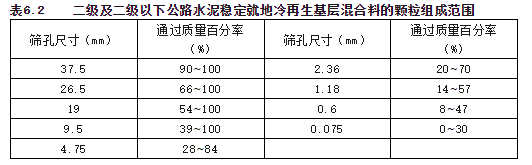
6.1.4 在水泥穩定就地冷再生層施工前,在原道路上取有代表性的銑刨料樣品嚴格按照相關規范和規程進行下列試驗:
6.1.4 Before the construction of the cement stabilized in-situ cold recycling layer, representative milling material samples shall be taken from the original road and subjected to the following tests in strict accordance with relevant specifications and regulations:
(1)顆粒分析;
(1) Particle analysis;
(2)液限和塑性指數;
(2) Liquid limit and plasticity index;
(3)擊實試驗;
(3) Compaction test;
(4)有機質含量(必要時做);
(4) Organic matter content (if necessary);
(5)硫酸鹽含量(必要時做)。
(5) Sulfate content (if necessary).
6.1.5 對級配不良的銑刨舊料,應通過摻加部分新料以改善其級配,對新加料應取所定料場中有代表性的樣品嚴格按照相關規范和規程進行下列試驗:
6.1.5 For milling old materials with poor grading, the grading should be improved by adding some new materials. Representative samples from the designated material yard should be taken for the new materials, and the following tests should be strictly conducted in accordance with relevant specifications and regulations:
(1)顆粒分析;
(1) Particle analysis;
(2)細集料液限和塑性指數;
(2) Liquid limit and plasticity index of fine aggregate;
(3)相對密度;
(3) Relative density;
(4)碎石或礫石的壓碎值;
(4) Crushing value of crushed stone or gravel;
(5)有機質含量(必要時做);
(5) Organic matter content (if necessary);
(6)硫酸鹽含量(必要時做)。
(6) Sulfate content (if necessary).
6.1.6 有機質含量超過2%或硫酸鹽含量超過0.25%的舊路混合料,不得用水泥穩定就地冷再生。
Old road mixtures with organic matter content exceeding 2% or sulfate content exceeding 0.25% shall not be stabilized with cement for on-site cold recycling.
6.1.7 選用初凝時間3h以上和終凝時間較長(宜在6h以上)的普通硅酸鹽水泥,不應使用快硬水泥、早強水泥以及已受潮變質的水泥。宜采用 32.5級或42.5級的水泥。
6.1.7 Ordinary Portland cement with an initial setting time of more than 3 hours and a final setting time of more than 6 hours should be selected. Fast hardening cement, early strength cement, and cement that has been affected by moisture and deterioration should not be used. Cement of grade 32.5 or 42.5 should be used.
6.1.8 凡是飲用水(含牲畜飲用水)均可用于水泥穩定就地冷再生施工。水質有疑問時應進行檢驗。
6.1.8 All drinking water (including livestock drinking water) can be used for on-site cold recycling construction of cement stabilization. When there are doubts about water quality, testing should be conducted.
6.1.9 石灰應為生石灰粉或消石灰,各項技術指標應符合《公路路面基層施工技術規范》(JTJ 034-2000)的有關要求。
6.1.9 Lime should be quicklime powder or hydrated lime, and all technical indicators should comply with the relevant requirements of the "Technical Specification for Construction of Highway Pavement Base" (JTJ 034-2000).
6.2 混合料設計方法
6.2 Mix design method
6.2.1 準備試樣并進行配合比設計
6.2.1 Prepare the sample and conduct mix design
1. 將代表試樣(舊混合料)完全風干,測定舊混合料完全風干后的含水量。
1. Fully air dry the representative sample (old mixture) and measure the moisture content of the old mixture after complete air drying.
2. 根據舊混合料和新加料的級配確定合成級配,繪制級配曲線,使設計合成級配在相應的級配范圍內。設計的合成級配宜接近表中級配范圍的中值。當反復調整不能滿意時,應更換新加料設計。更換新加料后其合成級配仍不能完全在相應的級配范圍內時,如僅為個別篩孔超出,可由終強度的無側限抗壓強度決定此道路是否適合再生,如大部分篩孔超出范圍,則此道路不適宜進行再生。
2. Determine the composite gradation based on the gradation of the old mixture and new additives, draw the gradation curve, and ensure that the designed composite gradation is within the corresponding gradation range. The designed composite gradation should be close to the median of the gradation range in the table. When repeated adjustments are unsatisfactory, a new feeding design should be replaced. When the composite gradation cannot be completely within the corresponding gradation range after replacing the new material, if only a few sieve holes exceed it, the unconfined compressive strength of the final strength can determine whether the road is suitable for regeneration. If most sieve holes exceed the range, the road is not suitable for regeneration.
3.將風干后的舊混合料分成以下五個部分:
3. Divide the air dried old mixture into the following five parts:
(1)粒徑大于37.5mm的材料;
(1) Materials with a particle size greater than 37.5mm;
(2)粒徑在19~37.5mm之間的材料;
(2) Materials with particle sizes between 19 and 37.5mm;
(3)粒徑在13.2~19mm之間的材料;
(3) Materials with particle sizes between 13.2-19mm;
(4)粒徑在4.75~13.2mm之間的材料;
(4) Materials with particle sizes ranging from 4.75mm to 13.2mm;
(5)小于4.75mm的材料。
(5) Materials smaller than 4.75mm.
4.將全部通過37.5mm的材料,再按照篩分結果重新組合成代表性試樣,并用19~37.5mm之間的材料替代37.5mm以上的材料。配10kg舊混合料計算過程見表6.3。
4. Combine all materials passing through 37.5mm according to the screening results to form a representative sample, and replace materials above 37.5mm with materials between 19-37.5mm. The calculation process for preparing 10kg old mixture is shown in Table 6.3.
表 6.3 代表試樣重新組合
Table 6.3 represents the recombination of samples
6.2.2 干密度和含水量的確定
6.2.2 Determination of maximum dry density and optimal moisture content
6.2.2.1 分別按下列五種水泥劑量配制同一種土樣、不同水泥劑量的混合料;
6.2.2.1 Prepare a mixture of the same soil sample and different cement dosages according to the following five cement dosages:;
(1)做基層用:4%、4.5%、5%、5.5%,6%,
(1) For grassroots use: 4%, 4.5%, 5%, 5.5%, 6%,
(2)做底基層用:4%、4.5%、5%、5.5%、6%
(2) For use as a base layer: 4%, 4.5%, 5%, 5.5%, 6%
注:在能估計合適劑量的情況下,可以將五個不同劑量縮減到三或四個,如果待穩定材料塑性指數大于12或(和)顆粒較細應適當提高水泥劑量(提高1%~2%)。
Note: If the appropriate dosage can be estimated, five different dosages can be reduced to three or four. If the plasticity index of the material to be stabilized is greater than 12 or (and) the particles are finer, the cement dosage should be appropriately increased (by 1% to 2%).
6.2.2.2 根據設計配合比確定的新舊料比例進行配料,配料時大于37.5mm的材料用19~37.5mm進行替代。
6.2.2.2 According to the design mix proportion, determine the ratio of new and old materials for batching. When batching, materials larger than 37.5mm should be replaced with 19-37.5mm.
6.2.2.3 按公式6.1確定試樣的干質量。
6.2.2.3 Determine the dry mass of the sample according to formula 6.1.
(6.1)
(6.1)
式中:
Where:
――試樣的干質量,g;
The dry mass of the sample, g;
――試樣的風干質量,g;
The air dried quality of the sample, g;
――風干試樣的含水量,%。
Moisture content of air dried samples,%.
6.2.2.4 按公式6.2確定穩定劑的用量。
6.2.2.4 Determine the dosage of stabilizer according to formula 6.2.
(6.2)
(6.2)
式中:
Where:
――水泥或石灰用量,g;
The amount of cement or lime used, g;
――水泥或石灰的百分比,%;
- Percentage of cement or lime,%;
――試樣的干質量,g。
The dry mass of the sample, g。
6.2.2.5 按照《公路工程無機結合料穩定材料試驗規程》(JTJ 057-94)T0804-94方法確定混合料的干密度和含水量。確定各種混合料的含水量和干(壓實)密度,少應做三個不同水泥劑量混合料的擊實試驗,即小劑量、中間劑量和劑量。其他兩個劑量混合料的含水量和干密度用內插法確定。
6.2.2.5 Determine the maximum dry density and optimal moisture content of the mixture according to the T0804-94 method in the "Test Code for Inorganic Bonding Materials in Highway Engineering" (JTJ 057-94). To determine the optimal moisture content and maximum dry (compacted) density of various mixtures, at least three compaction tests should be conducted for mixtures with different cement dosages, namely minimum dosage, intermediate dosage, and maximum dosage. The optimal moisture content and maximum dry density of the other two dosage mixtures were determined using interpolation.
6.2.3 穩定材料的準備
6.2.3 Preparation of Stable Materials
6.2.3.1 根據公式6.1計算試樣干質量。
6.2.3.1 Calculate the dry mass of the sample according to formula 6.1.
6.2.3.2根據公式6.2計算穩定劑用量。
6.2.3.2 Calculate the stabilizer dosage according to formula 6.2.
6.2.3.3按公式6.3確定加水百分比,并按式6.4確定需要加水的質量。
6.2.3.3 Determine the percentage of water added according to formula 6.3, and determine the required amount of water to be added according to formula 6.4.
(6.3)
(6.3)
(6.4)
(6.4)
式中:
Where:
――試樣的加水百分比,%;
-- Percentage of water added to the sample,%;
――試樣的含水量,%;
The optimal moisture content of the sample,%;
――風干試驗的含水量,%;
Moisture content of air drying test,%;
――加水質量,g;
-- Quality of water added, g;
――試樣干重,g;
-- Dry weight of the sample, g;
――穩定劑添加量,g。
-- stabilizer addition amount, g。
6.2.4 成型試件(靜壓成型)
6.2.4 Forming test piece (static pressure forming)
6.2.4.1 按規定壓實度分別計算不同水泥劑量的試件應有的干密度。
6.2.4.1 Calculate the dry density of specimens with different cement dosages according to the prescribed compaction degree.
6.2.4.2 根據含水量和計算的干密度制備試件。進行強度試驗時,作為平行試驗的少試件數量應不小于表6.4的規定。如試驗結果的偏差系數大于表中規定的值,則應重做試驗,并找出原因,加以解決。如不能降低偏差系數,則應增加試件數量。
6.2.4.2 Prepare specimens based on the optimal moisture content and calculated dry density. When conducting strength tests, the minimum number of specimens used as parallel tests should not be less than the provisions in Table 6.4. If the deviation coefficient of the test results is greater than the value specified in the table, the test should be redone, and the cause should be identified and resolved. If the deviation coefficient cannot be reduced, the number of specimens should be increased.

6.2.4.3 試件在溫度20±2℃、濕度大于95%的養護室內養生6d,浸水24h后,按《公路工程無機結合料穩定材料試驗規程》(JTJ057)進行無側限抗壓強度試驗。
6.2.4.3 The specimen shall be cured in a curing room with a temperature of 20 ± 2 ℃ and humidity greater than 95% for 6 days. After being immersed in water for 24 hours, an unconfined compressive strength test shall be conducted in accordance with the "Test Specification for Inorganic Bonding Materials in Highway Engineering" (JTJ057).
6.2.5 確定穩定劑的用量
6.2.5 Determine the optimal dosage of stabilizer
6.2.5.1 計算無側限抗壓強度試驗結果的平均值和偏差系數。
6.2.5.1 Calculate the average value and deviation coefficient of the unconfined compressive strength test results.
6.2.5.2 根據要求的強度標準,選定合適的水泥劑量,此劑量試件室內試驗結果的平均抗壓強度應符合公式6.5的要求:
6.2.5.2 According to the required strength standards, select the appropriate cement dosage, and the average compressive strength of the indoor test results of this dosage specimen should meet the requirements of formula 6.5:
≥Rd/(1-ZaCv) (6.5)
≥Rd/(1-ZaCv) (6.5)
式中:
Where:
Rd——設計抗壓強度;
Rd - Design compressive strength;
Cv——試驗結果的偏差系數(以小數計);
Cv - Deviation coefficient of test results (in decimal units);
Za——標準正態分布表中隨保證率(或置信度a)而變的系數,取保證為率90%,即Za=1.282。
Za - the coefficient in the standard normal distribution table that varies with the guarantee rate (or confidence level a), with a guarantee rate of 90%, i.e. Za=1.282.
6.2.5.3 工地人工撒布水泥,實際采用的水泥劑量應比室內試驗確定的劑量多0.5~1.0%;采用水泥稀漿車,實際采用的水泥劑量應比室內試驗確定的劑量多0~0.5%。
6.2.5.3 When manually spreading cement on construction sites, the actual cement dosage used should be 0.5-1.0% higher than the dosage determined by indoor tests; When using a cement slurry truck, the actual cement dosage used should be 0-0.5% higher than the dosage determined by indoor tests.
6.2.5.4 水泥的小劑量應不低于4%。
6.2.5.4 The minimum dosage of cement should not be less than 4%.
7 鋪筑試驗段
7 Paving test section
7.1 一般規定
7.1 General Provisions
7.1.1 每一工程開工前應鋪筑試驗段。
7.1.1 Before the commencement of each project, a test section should be laid.
7.1.2 根據道路結構形式和損壞狀況選取試驗段,使試驗段具有代表性。
7.1.2 Select the test section based on the road structure and damage condition to make it representative.
7.1.3 試驗段的長度不應短于200m。
The length of the test section should not be less than 200m.
7.1.4 再生時應嚴格控制再生深度,如遇問題應及時解決。
7.1.4 During regeneration, the regeneration depth should be strictly controlled, and any problems should be promptly resolved.
7.1.5 通過試驗段的鋪筑應獲得以下資料:
7.1.5 The following information should be obtained through the paving of the test section:
(1)再生材料的級配。檢驗再生后的材料,與試驗室進行配合比設計時的級配進行對比,看其是否在允許的波動范圍內。
(1) Grading of recycled materials. Inspect the regenerated material and compare it with the gradation during the mix design in the laboratory to see if it is within the allowable fluctuation range.
(2)確定再生機的行進速度和轉子速度。
(2) Determine the travel speed and rotor speed of the regeneration machine.
(3)確定壓實工藝。
(3) Determine the compaction process.
(4)了解舊路的膨脹性。
(4) Understand the expansibility of old roads.
7.1.6 通過鋪筑試驗段,操作人員、監理人員以及管理人員應了解再生材料的有關特性。
7.1.6 Through the paving test section, operators, supervisors, and managers should have a comprehensive understanding of the relevant characteristics of recycled materials.
7.2 試驗段施工
7.2 Experimental section construction
7.2.1 按要求選定試驗段。
7.2.1 Select the test section as required.
7.2.2 根據經驗和所用再生機械的特點,制定3~5種不同的再生機行進速度和轉子速度的組合方案,按再生深度對舊路進行銑刨,取銑刨后具有代表性的材料送往試驗室進行篩分,選擇級配接近理想級配的方案作為施工時再生機行進速度和轉子速度的方案。
7.2.2 Based on experience and the characteristics of the recycling machinery used, develop 3-5 different combinations of recycling machine travel speed and rotor speed, mill the old road according to the recycling depth, take representative materials after milling and send them to the laboratory for screening, and select the scheme with the closest gradation to the ideal gradation as the scheme for recycling machine travel speed and rotor speed during construction.
7.2.3 按照7.2.2確定的再生機行進速度和轉子速度,根據再生深度對舊路銑刨,取銑刨后具有代表性的材料樣品送往試驗室進行室內配合比設計。
7.2.3 According to the determined speed of the regeneration machine and rotor speed in 7.2.2, the old road is milled according to the regeneration depth. Representative material samples after milling are taken and sent to the laboratory for indoor mix design.
7.2.4 按照室內試驗結果,在舊路上攤鋪新加料,但不添加穩定劑,按7.2.2確定的方案進行銑刨,取銑刨后具有代表性的材料樣品送往試驗室進行篩分,如果篩分后的級配與室內設計級配超過工地允許波動范圍,應調整再生機速度和轉子速度,使銑刨后的級配與室內設計級配相比波動在允許范圍內。
7.2.4 According to the indoor test results, new materials shall be spread on the old road without adding stabilizers. Milling shall be carried out according to the scheme determined in 7.2.2. Representative material samples after milling shall be taken and sent to the laboratory for screening. If the screened gradation exceeds the allowable fluctuation range of the construction site compared to the indoor design gradation, the speed of the regeneration machine and rotor shall be adjusted to ensure that the milled gradation fluctuates within the allowable range compared to the indoor design gradation.
7.2.5 按照本指南進行嚴格施工,采用1-3種壓實方案進行施工(包括壓路機噸位、碾壓順序、遍數等),以確定為合理的碾壓方案。
7.2.5 Strictly carry out construction according to this guide, using 1-3 compaction schemes (including roller tonnage, rolling sequence, number of passes, etc.) to determine the most reasonable compaction scheme.
7.2.6 取再生機后經銑刨、拌和的混合料,送往試驗室,測定再生混合料的含水量、水泥劑量,并按《公路工程無機結合料穩定材料試驗規程》(JTJ 57-94)要求成型試件,測定其7d無側限抗壓強度。
7.2.6 Take the mixture after milling and mixing from the recycling machine, send it to the laboratory, measure the moisture content and cement dosage of the recycled mixture, and form the test piece according to the requirements of the "Test Code for Stable Materials of Inorganic Bonding Materials in Highway Engineering" (JTJ 57-94) to determine its 7-day unconfined compressive strength.
7.2.7 對試驗段的彎沉、壓實度、平整度、厚度、寬度進行檢測,其應滿足現行相關規范和設計要求。
7.2.7 The deflection, compaction degree, flatness, thickness, and width of the test section shall be tested to meet the current relevant specifications and design requirements.
7.2.8 根據試驗段的結果終確定再生混合料的級配、施工時采用的再生機行進速度、轉子速度及再生結構層壓實工藝。
7.2.8 Based on the results of the test section, determine the gradation of the recycled mixture, the speed of the recycling machine used during construction, the rotor speed, and the compaction process of the recycled structural layer.
8 施工工藝
8 Construction Techniques
8.1 水泥穩定就地冷再生的工藝流程宜按圖8.1的順序進行
The process flow of on-site cold regeneration for cement stabilization should be carried out in the order shown in Figure 8.1
8.2 整個施工及養護過程中,應對再生路段(路幅)封閉交通,各路口設置警示牌,提醒司機及行人。
During the entire construction and maintenance process, the regenerated road section (road width) should be closed to traffic, and warning signs should be set up at each intersection to remind drivers and pedestrians.
圖8.1 水泥穩定就地冷再生工藝流程
Figure 8.1 Cement stabilization on-site cold recycling process flow
8.3 施工放樣
8.3 Construction layout
8.3.1 在再生施工之前,應在道路的兩側放置一系列的標樁(桿)作為基線,用來恢復道路的中心線。
Before the regeneration construction, a series of stakes (poles) should be placed on both sides of the road as baselines to restore the centerline of the road.
8.3.2 標樁(桿)的間距,曲線距離不應超過20米,直線距離不應超過40米。
8.3.2 The spacing between stakes (poles) should not exceed 20 meters for curved lines and 40 meters for straight lines.
8.4 準備原道路
8.4 Prepare the original road
8.4.1 原道路表面(包括不需要再生的相臨行車道和路肩)的石塊、垃圾、雜草等雜物和積水,并清理邊線。
8.4.1 Remove stones, garbage, weeds, and other debris and standing water from the original road surface (including adjacent lanes and shoulders that do not require regeneration), and clean the edges.
8.4.2 再生路段上存在的井蓋等類似結構物。
8.4.2 Remove manhole covers and similar structures from the regeneration section.
8.4.3 對原路的翻漿、車轍、沉陷、波浪、坑槽等病害進行處理,使原路基本平整。
8.4.3 Treat the damages such as mud heave, ruts, subsidence, waves, potholes, etc. on the original road to make it basically flat.
8.5 準備新加料
8.5 Prepare new ingredients
8.5.1 計算材料用量:
8.5.1 Calculation of Material Consumption:
(1)根據原道路再生深度內的平均密度,計算每平米新料的添加量。
(1) Calculate the amount of new material added per square meter based on the average density within the original road regeneration depth.
(2)根據每車料的質量或體積,計算每車料的堆放距離。
(2) Calculate the stacking distance of each vehicle based on its mass or volume.
(3)人工擺放和撒布水泥,應根據水泥劑量,計算每一水泥穩定層需要的水泥用量,并確定水泥擺放的縱橫間距。使用水泥稀漿車,應計算水泥漿的噴入量。
(3) When manually placing and spreading cement, the amount of cement required for each square meter of cement stabilization layer should be calculated based on the cement dosage, and the vertical and horizontal spacing of cement placement should be determined. When using a cement slurry truck, the amount of cement slurry sprayed should be calculated.
8.5.2 新加料裝車時,應控制每車料的數量基本相等。
When loading new materials, the quantity of each vehicle should be controlled to be basically equal.
8.5.3 在同一料場供料的路段內,由遠到近將料按上述計算距離卸置于原路面的中間。卸料距離應嚴格掌握,避免有的路段料不夠或過多。
8.5.3 In the section of the same material yard where materials are supplied, the materials shall be unloaded in the middle of the original road surface according to the calculated distance from far to near. The unloading distance should be strictly controlled to avoid insufficient or excessive material on some road sections.
8.5.4 將新加料均勻地撒布在舊路面上,并檢查新加料撒布是否均勻。
8.5.4 Spread the new material evenly on the old road surface and check if the new material is evenly distributed.
8.6 冷再生機組就位
8.6 Cold regeneration unit in place
8.6.1 使用推桿連接再生機組,并連接所有與再生機相連的管道。
8.6.1 Use push rods to connect the regeneration unit and connect all pipelines connected to the regeneration machine.
8.6.2 檢查再生機操作人員是否已將所有與穩定劑添加量有關的數據輸入計算機。
8.6.2 Check if the operator of the regeneration machine has entered all data related to the amount of stabilizer added into the computer.
8.6.3 人工擺放和撒布水泥。使用水泥稀漿車,應檢查水泥稀漿車內的水泥和水是否充足。
8.6.3 Manual placement and spreading of cement. When using a cement slurry truck, it is necessary to check whether the cement and water inside the truck are sufficient.
8.6.4 排除系統中的所有空氣并確保所有閥門均處于全開度位置。
8.6.4 Remove all air from the system and ensure that all valves are in the fully open position.
8.6.5 檢查再生路段內的導向標志,確保導向標志明確。
8.6.5 Check the directional signs within the regeneration section to ensure that they are clear.
8.6.6 對再生施工中所需要的其它機械設備進行的檢查。
8.6.6 Conduct a comprehensive inspection of other mechanical equipment required for regeneration construction.
8.7 擺放和撒布水泥(使用水泥稀漿車時無此步驟)
8.7 Placing and spreading cement (this step is not required when using a cement slurry truck)
8.7.1 按本章第8.5.2條計算出的每袋水泥的縱橫間距,在舊路上做好安放標記。
8.7.1 Calculate the longitudinal and transverse spacing of each bag of cement according to Article 8.5.2 of this chapter, and mark the placement on the old road.
8.7.2 應將水泥當日直接送到撒布路段,卸在做標記的地點,并檢查有無遺漏和多余。
8.7.2 The cement should be directly delivered to the spreading section on the same day, unloaded at the marked location, and checked for omissions and excess.
8.7.3 將水泥均勻攤開,并注意使每袋水泥的撒布面積相等。水泥撒布完后,表面應沒有空白位置,也沒有水泥過分集中的地點。
8.7.3 Spread the cement evenly and ensure that the spreading area of each bag of cement is equal. After the cement is spread, there should be no blank spaces on the surface or areas where cement is excessively concentrated.
8.8 冷再生機銑刨與拌和
8.8 Cold recycling machine milling and mixing
8.8.1 冷再生機推動稀漿車或水車在原路面上行進。
8.8.1 The cold regeneration machine drives the slurry truck or water truck to travel on the original road surface.
8.8.2 冷再生機行進速度應根據路面損壞狀況和再生深度進行調整,一般為6m/min~12m/min,使得銑刨后料的級配波動范圍不大。網裂嚴重地段應降低再生機組行進速度,提高銑刨轉子轉速。
8.8.2 The traveling speed of the cold recycling machine should be adjusted according to the damage condition of the road surface and the depth of regeneration, generally ranging from 6m/min to 12m/min, so that the gradation fluctuation range of the milled material is not large. In areas with severe mesh cracking, the speed of the regeneration unit should be reduced and the milling rotor speed should be increased.
8.8.3 再生機后應有專人跟隨,隨時檢查再生深度、水泥含量和含水量,并配合再生機操作員進行調整。
8.8.3 After the regeneration machine, there should be a dedicated person to follow and check the regeneration depth, cement content, and moisture content at any time, and cooperate with the regeneration machine operator to make adjustments.
8.8.4 施工中再生深度的檢查以相鄰已經再生或原路面為標準,用鋼纖刺入土中,測量其刺入深度,看其深度是否合格。
8.8.4 The inspection of the depth of regeneration during construction shall be based on the adjacent regenerated or original road surface. Steel fibers shall be used to pierce into the soil, and the penetration depth shall be measured to see if it is qualified.
8.8.5 應在作業面邊緣固定導向線以幫助操作者。
8.8.5 Guide lines should be fixed at the edge of the work surface to assist the operator.
8.8.6 若進行多刀施工時,應時刻注意搭接的寬度,保證搭接寬度。
8.8.6 When carrying out multi blade construction, attention should be paid to the width of the overlap at all times to ensure the overlap width.
8.8.7 再生機后宜安排4~5人處理邊線和清理混合料中的雜質以及每刀起始位置的余料,以防止影響縱向接縫、橫向接縫、平整度和再生材料的密實性。
8.8.7 After regeneration, it is advisable to arrange 4-5 people to handle the edges and clean up impurities in the mixture, as well as the remaining material at the starting position of each knife, to prevent affecting the longitudinal joints, transverse joints, flatness, and compactness of recycled materials.
8.8.8 帶有熨平板的再生機,應經常檢查熨平板后混合料的厚度。
8.8.8 Regeneration machines with ironing plates should regularly check the thickness of the mixture after ironing.
8.8.9 在施工過程中,對混合料的級配、再生深度、水(或水泥稀漿)的噴入量有任何疑問時,應停止施工,等問題解決后再繼續施工。
8.8.9 During the construction process, if there are any questions about the grading, regeneration depth, or water (or cement slurry) injection amount of the mixture, the construction should be stopped and the problem should be resolved before continuing.
8.8.10 每次再生的長度以保證后續作業能正常進行為宜,應認真組織施工,使再生的長度盡可能長些,以減少橫向接縫。一次(不停機)再生的長度一般為150m~250m。
8.8.10 The length of each regeneration should be ensured to ensure the normal progress of subsequent operations. Construction should be carefully organized to make the regeneration length as long as possible to reduce horizontal joints. The length of a single (non-stop) regeneration is generally between 150m and 250m.
8.8.11 每段再生結束后,應檢查銑刨轂的刀架、刀頭,發現損壞立即更換。
8.8.11 After each regeneration is completed, the tool holder and cutting head of the milling hub should be inspected, and any damage should be replaced immediately.
8.9. 碾壓整形
8.9. Rolling and shaping
8.9.1 根據路寬、壓路機的輪寬和輪距的不同,制訂碾壓方案,應使各部分碾壓到的次數盡量相同,路面的兩側應多壓2~3遍。
8.9.1 According to the differences in road width, roller width, and wheelbase, a rolling plan should be formulated to ensure that each part is rolled as frequently as possible, and the two sides of the road surface should be rolled 2-3 times more.
8.9.2 使用輪胎式再生機時,在整形之前,必須壓實輪跡間松散的材料。
When using a tire type regeneration machine, the loose material between the wheel tracks must be compacted before shaping.
8.9.3 在再生機后應緊跟一臺鋼輪振動壓路機或凸塊式振動壓路機進行初壓,采用高幅低頻進行壓實,壓實遍數應足以保證再生層底部2/3厚度范圍內的壓實度達到規定要求。鋼輪壓路機的工作速度不得超過3km/h。
8.9.3 After the regeneration machine, a steel wheel vibration roller or a convex block vibration roller should be followed for initial compaction, using high amplitude and low frequency compaction. The number of compaction passes should be sufficient to ensure that the compaction degree within 2/3 of the thickness range of the bottom of the regeneration layer meets the specified requirements. The working speed of the steel wheel roller shall not exceed 3km/h.
8.9.4 在初壓完成后,應立即用平地機整形。在直線段,平地機由兩側向路中心進行刮平;在平曲線段,平地機由內側向外側進行刮平。必要時,再返回刮一遍。
8.9.4 After the initial pressing is completed, the grader should be used immediately for shaping. In the straight section, the grader flattens from both sides towards the center of the road; On the flat curve section, the grader flattens from the inside to the outside. If necessary, go back and scrape again.
8.9.5 對于局部低洼處,應用齒耙將其表層5cm以上耙松,并用新拌的混合料進行找平。
8.9.5 For locally low-lying areas, use a toothed rake to loosen the surface layer by more than 5cm and level it with freshly mixed material.
8.9.6 整形時應將高處料直接刮出路外,不應形成薄層貼補現象。
During plastic surgery, the high material should be directly scraped out of the road without forming a thin layer of patching.
8.9.7 在整形過程中,嚴禁任何車輛通行,并保持無明顯的粗細集料離析現象。
8.9.7 During the plastic surgery process, it is strictly prohibited for any vehicle to pass through and there should be no obvious separation of coarse and fine aggregates.
8.9.8 整形后,當混合料的含水量為含水量時,應立即用光輪壓路機先以高幅低頻振動模式后以低幅高頻模式進行壓實。直線和不設超高的平曲線段,由路肩向路中心碾時,應重疊1/2輪寬,后輪必須超過兩段的接縫處,后輪壓完路面全寬時,即為一遍。一般需碾壓6~8遍。壓路機的碾壓速度,頭兩遍以采用1.5~1.7km/h為宜,以后宜采用2.0~2.5km/h。
After shaping, when the moisture content of the mixture reaches the optimal moisture content, a smooth wheel roller should be used immediately to compact it in high amplitude low-frequency vibration mode and then in low amplitude high-frequency mode. When rolling straight lines and flat curved sections without superelevation from the shoulder to the center of the road, they should overlap by 1/2 of the wheel width, and the rear wheel must exceed the joint between the two sections. When the rear wheel presses the full width of the road surface, it is considered as one pass. Generally, it needs to be rolled 6-8 times. The rolling speed of the road roller should be 1.5-1.7km/h for the first two passes, and 2.0-2.5km/h for subsequent passes.
8.9.9 嚴禁壓路機在已完成的或正在碾壓的路段上調頭或急剎車,應保證再生層表面不受破壞。
8.9.9 It is strictly prohibited for the roller to turn around or brake abruptly on the completed or rolling road section, and the surface of the regeneration layer should be ensured not to be damaged.
8.9.10 碾壓過程中,再生層的表面應始終保持濕潤,如水分蒸發過快,應及時補撒少量的水,但嚴禁大量灑水碾壓。
During the rolling process, the surface of the recycled layer should always be kept moist. If the water evaporates too quickly, a small amount of water should be sprinkled in a timely manner, but it is strictly prohibited to sprinkle a large amount of water for rolling.
8.9.11 碾壓過程中,如有“彈簧”、松散、起皮等現象,應及時翻開重新拌和(加適量的水泥)或用其他方法處理,使其達到質量要求。
During the rolling process, if there are "springs", looseness, peeling and other phenomena, they should be promptly opened and re mixed (with an appropriate amount of cement) or treated with other methods to meet the quality requirements.
8.9.12 經過拌和、整形的水泥穩定就地冷再生層,宜在水泥初凝前并應在試驗確定的延遲時間內完成碾壓,并達到要求的密實度,同時沒有明顯的輪跡。
8.9.12 After mixing and shaping, the cement stabilized in-situ cold recycling layer should be compacted before the initial setting of the cement and within the delay time determined by the test, and achieve the required density without obvious wheel marks.
8.9.13 在碾壓結束之前,用平地機再終平一次,使其縱向順適,路拱和超高符合設計要求。終平應仔細進行,必須將局部高出部分刮除并掃出路外;對于局部低洼之處,不再進行找補,可留待鋪筑瀝青面層時處理。
Before the rolling is completed, use a grader to level it again to make it longitudinally smooth and the road arch and superelevation meet the design requirements. The final leveling should be carried out carefully, and the locally raised parts must be scraped off and swept out of the road; For locally low-lying areas, no further repairs will be made and can be left to be dealt with when laying the asphalt surface layer.
8.10 接縫和調頭處的處理
8.10 Treatment of seams and turning points
8.10.1 縱向接縫的處理
8.10.1 Treatment of longitudinal seams
(1)道路寬度小于7m,縱向重疊較多時,不宜半幅施工,應考慮全幅施工,以減少重疊量,提高施工效率。
(1) When the road width is less than 7m and there is a lot of longitudinal overlap, it is not suitable to carry out half width construction. Full width construction should be considered to reduce the amount of overlap and improve construction efficiency.
(2)一般重疊寬度為50-150mm。
(2) The general overlap width is 50-150mm.
(3)路面材料越厚,材料粒度越粗,重疊量越大。
(3) The thicker the pavement material, the coarser the particle size of the material, and the greater the overlap.
(4)相鄰兩次作業間隔12h以上時,重疊量應增加。
(4) When the interval between two adjacent assignments is more than 12 hours, the overlap should be increased.
(5)在縱向接縫上,根據已建再生層的完成時間,改變水泥稀漿(或水)的噴入量。
(5) On the longitudinal joint, adjust the amount of cement slurry (or water) sprayed according to the completion time of the existing regeneration layer.
(6)縱向接縫的位置應盡量避開慢行、重型車輛的輪跡。
(6) The position of longitudinal joints should avoid the wheel tracks of slow-moving and heavy vehicles as much as possible.
8.10.2 橫向接縫的處理
8.10.2 Treatment of transverse joints
(1) 應對所形成的橫向接縫認真處理,施工中應盡量減少停機現象。
(1) Handle the horizontal joints carefully and minimize downtime during construction.
(2) 停機超過水泥初凝時間,再生機再次施工時,必須將整個再生機后退再生過的路段1.5m的距離,并重新撒布水泥。
(2) When the shutdown exceeds the initial setting time of the cement and the regeneration machine is restarted, the entire regeneration machine must be moved back to a distance of 1.5 meters from the regenerated section and the cement must be re spread.
8.10.3 調頭處的處理
8.10.3 Handling of Turning Points
如機械必須到已壓成的水泥穩定就地冷再生層上調頭,應采取措施保護調頭作業段。一般可在準備用于調頭的約8~10m長的穩定土上,先覆蓋一張厚塑料布或油氈紙,然后鋪上約10cm厚的土、砂或砂礫。
If the machinery must be turned on the stabilized on-site cold regeneration layer of the already pressed cement, measures should be taken to protect the turning operation section. Generally, on a stable soil of about 8-10 meters long that is prepared for turning, a thick plastic cloth or oil felt paper can be covered first, and then about 10 cm thick soil, sand or gravel can be laid on top.
9 養生及交通管制
9 Health Preservation and Traffic Control
9.1 水泥穩定就地冷再生層宜養生7d后鋪筑上層混合料。如果上層混合料仍為無機結合料穩定類材料時,宜在下層表面撒少量水泥或水泥漿。
9.1 The cement stabilized in-situ cold regeneration layer should be cured for 7 days before laying the upper layer mixture. If the upper mixture is still a stable inorganic binder material, it is advisable to sprinkle a small amount of cement or cement slurry on the surface of the lower layer.
9.2 每一段碾壓完成并經壓實度檢查合格后,應立即開始養生。
After each section of compaction is completed and passes the compaction degree inspection, the curing process should begin immediately.
9.3 宜采用覆蓋(吸水土工布等)進行養生。養生結束后,必須將覆蓋物干凈。
9.3 It is advisable to use coverings (such as absorbent geotextiles) for health preservation. After the health preservation is completed, the covering must be cleaned thoroughly.
9.4 對于基層,可采用瀝青乳液進行養生。
9.4 For the base course, asphalt lotion can be used for curing.
9.5 無上述條件時,也可用灑水車經常灑水進行養生。每天灑水的次數應視氣候而定。整個養生期間應始終保持穩定土層表面潮濕,應注意表層情況,必要時,用兩輪壓路機壓實。
When the above conditions are not met, a sprinkler truck can also be used to regularly sprinkle water for health preservation. The frequency of watering per day should depend on the climate. Throughout the entire health preservation period, the surface of the soil layer should be kept stable and moist. Attention should be paid to the surface condition, and if necessary, a two wheeled roller should be used to compact it.
9.6 基層的養生期不宜少于7d。
The health maintenance period at the grassroots level should not be less than 7 days.
9.7 在養生期間未采用覆蓋措施的水泥穩定就地冷再生層上,除灑水車外,應封閉交通。不能封閉交通時,應限制重車通行,其他車輛的車速不應超過30km/h。
During the health preservation period, if no covering measures are taken on the cement stabilized in-situ cold regeneration layer, traffic should be closed except for the sprinkler truck. When traffic cannot be closed, the passage of heavy vehicles should be restricted, and the speed of other vehicles should not exceed 30km/h.
10 質量控制
10 Quality Control
10.1 材料應滿足混合料組成設計中相關要求。
10.1 The material should meet the relevant requirements in the mix composition design.
10.2 嚴格按照施工工藝要求認真施工。
10.2 Strictly follow the construction process requirements and construct diligently.
10.3 如發生未預料的特殊情況,可能會影響工程質量的應立即停工,待問題解決后再繼續施工。
10.3 In case of unforeseen special circumstances that may affect the quality of the project, the work should be immediately suspended until the problem is resolved before resuming construction.
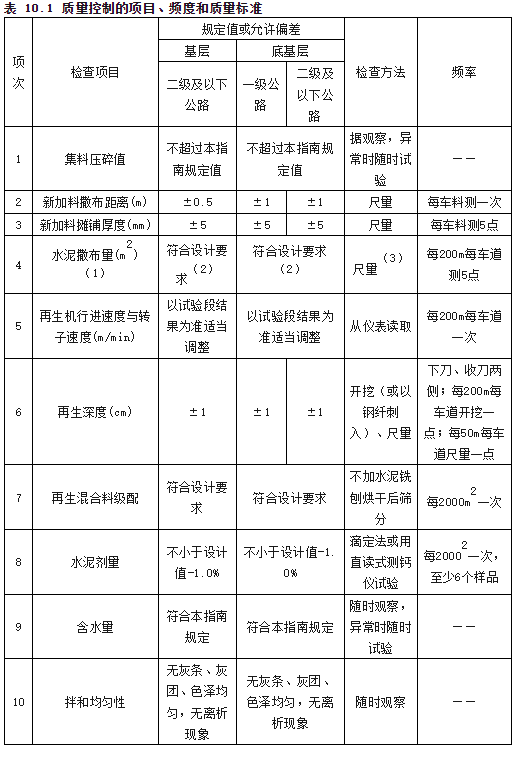
10.4 質量控制標準應符合表10.1要求,評定標準應符合表10.2要求,表中允許偏差均指與設計值之差。
10.4 The quality control standards shall comply with the requirements of Table 10.1, and the evaluation criteria shall comply with the requirements of Table 10.2. The allowable deviations in the table refer to the difference from the design values.
10.5 包括再生層在內的其他檢測項目應符合《公路工程質量檢驗評定標準》(JTG F80/1-2004)中相關規定。
10.5 Other testing items, including the regeneration layer, shall comply with the relevant provisions of the "Quality Inspection and Evaluation Standards for Highway Engineering" (JTG F80/1-2004).
10.6 碾壓合格后應立即覆蓋或灑水養生,養生期應符合指南要求。
10.6 After passing the compaction, it should be immediately covered or watered for curing, and the curing period should meet the requirements of the guidelines.

本文由 冷再生機租賃 友情奉獻.更多有關的知識請點擊 http://www.lvuee.com/ 真誠的態度.為您提供為的服務.更多有關的知識我們將會陸續向大家奉獻.敬請期待.
This article is a friendly contribution from Cold Recycling Machine Rental For more related knowledge, please click http://www.lvuee.com/ Sincere attitude To provide you with comprehensive services We will gradually contribute more relevant knowledge to everyone Stay tuned
閱讀/ Recommended reading
- 冷再生機租賃:道路冷再生時粒徑過大該怎么處理 2026-01-13
- 冷再生機租賃問題解決:冷再生在施工中常見的難題 2026-01-10
- 冷再生機租賃:乳化瀝青與泡沫瀝青冷再生技術發展綜述 2026-01-05
- 冷再生機租賃:瀝青路面冷再生技術的環境、經濟及性能綜合評估 2026-01-04
我國現階段公路使用情況,呈現公路養護與維修任務繁重,養護技術相對建設技術來講較為落后的特點。傳統的公路維修工藝多采用挖除舊瀝青路面,重新加鋪新的瀝青面層的方式。此種施工工藝存...